Health Information System
The problem
Health operations involve connected workflows for patient enrollment, programs, clinical users, reporting, and protected access. The backend needs to keep those concerns understandable as the system grows.
What I built
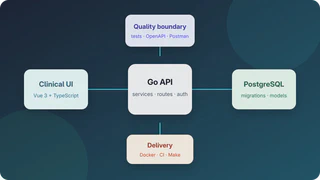
I built a Go backend backed by PostgreSQL and paired it with a Vue 3 and TypeScript frontend. The repository separates handlers, services, repositories, middleware, models, and routes so business rules and infrastructure concerns remain reviewable.
The public code includes JWT middleware, patient and program routes, database migrations and seed data, Swagger/OpenAPI specifications, Postman test evidence, repository and route tests, Docker support, a Makefile, and CI configuration.
Engineering decisions
- Layered backend boundaries keep HTTP handling, business logic, and database access from collapsing into one place.
- PostgreSQL modelling and migrations make the data structure explicit and repeatable.
- JWT authentication and validation protect workflows at the API boundary.
- Tests and API specifications give other developers ways to verify behavior without reading every implementation detail.
- Docker and CI tooling make the project easier to run and evaluate consistently.
What this demonstrates
Go service design, relational data modelling, API documentation, authentication, testable architecture, frontend integration, and deployment-minded delivery.
Scope note: This is a portfolio system, not a claim of clinical production certification. The live frontend and public repository are provided for technical evaluation.
