Application Flow Tracker
The problem
Teams reviewing grants, job applications, or admissions often lose context across spreadsheets, messages, and manual status updates. They need a clear record of each application, its review, the decision, and the comments behind it.
What I built
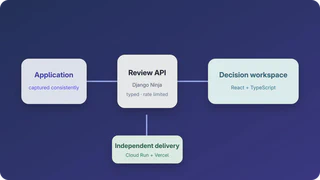
Application Flow Tracker separates a Django Ninja backend from a React and TypeScript frontend. It tracks applications from draft through submission, review, approval, rejection, or requests for more information. UUID-based tracking keeps references stable, while typed schemas define the API contract.
The demo frontend is deployed on Vercel and the API has a Google Cloud Run endpoint, showing the path from local code to independently deployed services.
Engineering decisions
- Typed API schemas make request and response contracts explicit for both frontend and backend work.
- Separate services allow the interface and API to evolve and deploy independently.
- Structured review states turn an informal process into a traceable workflow.
- Anonymous throttling and validation reduce abuse and malformed input at the boundary.
- REST client examples and tests provide quick, repeatable verification paths.
What this demonstrates
Workflow modelling, Python API design, TypeScript integration, cloud deployment, defensive API practices, and the ability to deliver a usable system across the stack.
Scope note: The repository transparently documents follow-up work such as RBAC, Redis caching, Docker, and fuller CI/CD. These are improvement targets, not current-feature claims.
